
Taiwan is the standout equity market of 2026, and we believe the best is not yet behind it. The Taiwan Stock Exchange Capitalization Weighted Stock Index (TAIEX) closed at a record 49,823 on 6 October 2026, MSCI Taiwan is up 75.5% year-to-date in US dollars, and Taiwan's earnings are being upgraded faster than any other market in Asia. The Aritifical Intelligence (AI) investment cycle is broadening from the chipmaker into the wider hardware supply chain — exactly where the LionGlobal Taiwan Fund is invested.
MARKET REVIEW
September and the third quarter
Taiwan was the best-performing emerging market in September and in the third quarter, delivering gains while most of the world struggled with higher bond yields, US$100+ oil and a stronger dollar.
- New record highs. The TAIEX closed above 48,000 for the first time on 25 September and at 48,476 on 2 October, then added a further 2.8% over the next two sessions to close at 49,823 on 6 October.
- The rally broadened. Leadership rotated from energy and financials in early September to semiconductors and hardware, and then to smaller companies, with the Taipei Exchange (Over The Counter) index up 3.0% in the week to 2 October.
- The AI supply chain led. Year-to-date, MSCI Taiwan excluding Taiwan Semiconductor Manufacturing Company (TSMC) is up 93% versus 61% for TSMC; other semiconductors are up 143% and tech hardware 81%.
- Leaders in our universe. Over the three months to end September, thermal specialist Jentech rose 98.3% and Application-Specific integrated circuit (ASIC) designer Global Unichip 65.9%; in September alone Global Unichip gained 31.8% and MediaTek 25.4%.
- Resilience under pressure. The market absorbed the Fed's first rate hike since 2023 (16 September), a US 10-year yield of 5.29% and oil above US$100 per barrel. Strong company results did the heavy lifting.
MACRO BACKDROP
An economy firing on all cylinders
Taiwan's economy is having an exceptional year. The central bank now expects 2026 Gross Domestic Product (GDP) growth of 11.48%, up from a 2.68% forecast a year earlier. Growth is led by AI exports but is spreading to private consumption, investment and non-tech industry.
- Demand is broad, not narrow. Non-tech export orders rose 30.8% in August, domestic demand contributed 54% of second-quarter growth, and the central bank lifted its 2026 private-consumption forecast from 3.4% to 5.0%.
- Inflation is contained. Inflation is running only slightly above 2% — well below the US, the Euro area and Korea — and is expected to ease below 2% from the second quarter of 2027.
- Monetary policy is supportive. The central bank held rates and eased mortgage rules for second homes (Loan-To-Value (LTV) cap raised from 60% to 70%). Even economists who expect tightening see only small 12.5 basis point (bp) steps.
- Currency. Bank of America (BofA) expects the Taiwan dollar to strengthen towards 31.60 per US dollar over the next six months (31.78 on 6 October).
EARNINGS AND VALUATION
Growth is doing the work
This rally is backed by earnings, not just multiples. Taiwan-listed companies earned a record NT$1.8 trillion in 2Q26, up 110% year on year1, and analysts are still 1 raising forecasts.
- Fastest upgrades in the region. Consensus 2026 and 2027 Earnings Per Share (EPS) for Taiwan rose 3.9% and 4.6% in September alone, against 1.2% and 1.8% for emerging markets; over three months the upgrades total 14.2% and 17.4%.
- Strong growth this year and next. Consensus expects MSCI Taiwan EPS to grow 64.7% in 2026 and 30.6% in 2027. KGI forecasts 2027 earnings growth of 34.5% for technology excluding TSMC, ahead of 28.6% for TSMC itself.
- Visible in monthly sales. Listed-company revenue rose 55% year on year in August, and sales at UBS's Taiwan tech coverage rose 69%.
Valuations are above their long-term averages, but in our view this is justified by an earnings cycle far stronger than past upcycles. As KGI puts it, it is “too early to place the AI boom in bubble territory.”
FLOWS AND POSITIONING
Global investors are still under-owned
Taiwan has rallied without global investors fully on board, which we see as fuel for the next leg. Foreign investors sold a net US$35.9bn of Taiwan equities this year as at 6 October, yet the market rose over 70% on the strength of domestic buying and earnings.
- Domestic money is the anchor. Local institutions have bought a net US$24.7bn this year and Taiwan equity funds have taken in US$45.9bn.
- Global funds are underweight and starting to return. Taiwan is the largest underweight for both Asia ex-Japan (−510bp) and global Emerging Markets (EM) (−420bp) active funds, with positioning near 10-year lows. Foreign investors turned net buyers in early October, adding US$2.7bn by 6 October.
- The rotation is into the supply chain. Global EM funds have moved from a 50bp underweight in Taiwan tech excluding TSMC (April 2025) to a 100bp overweight. The companies they added most over six months — Chroma, Advanced Semiconductor Engineering (ASE), Asia Vital Components, Elite Material and Unimicron — are all holdings of this fund.
- Positioning has been cleaned up. Crowding in tech outside TSMC has unwound, and leveraged singlestock ETF assets have fallen from US$37bn to US$10bn.
OUTLOOK: WHY WE STAY CONSTRUCTIVE INTO 2027
We expect Taiwan equities to keep moving higher over the next 12 months, with further gains likely led by the AI hardware supply chain.
Four reasons the cycle has further to run
| 1. AI spending is still accelerating. | 2. Supply, not demand, is the constraint. |
| UBS expects hyperscaler capex to grow 95% in 2026 and another 43% in 2027. Morgan Stanley sees 2027 cloud capex near US$1.4 trillion, about 17% above consensus. |
Advanced packaging, leading-edge wafers, substrates, high-end printed circuit board (PCB) materials and power components are all short, giving Taiwan's suppliers pricing power: Copper-Clad Laminate (CCL) prices are expected to rise another 15–20% and Ajinomoto Build-up Film (ABF) substrate prices again in 4Q26. |
| 3. A new wave of AI platforms ramps from 4Q26. | 4. Apple adds a second engine. |
| Nvidia's Vera Rubin racks sell for US$7–8 million, about 70% more than Blackwell, with roughly 3.7 times the PCB content per rack. Custom AI chips are expected to outnumber GPUs for the first time in 2027. | Apple's first foldable iPhone launches an upgrade cycle; Taiwan's Apple suppliers have seen forward EPS rise about 9% in the three months after past major launches. |
Near-term catalysts
- TSMC third-quarter results and fourth-quarter guidance on 15 October; brokers expect gross margin at or above the top of guidance and a raised full-year growth target.
- September and October monthly sales, which are tracking well ahead of seasonal patterns.
- Possible new custom-chip wins for MediaTek in 4Q26, and first shipments of co-packaged-optics (CPO) test equipment.
INVESTMENT STRATEGY AND FUND POSITIONING
The LionGlobal Taiwan Fund is concentrated where the AI build-out is most supply-constrained — the components, materials, cooling, packaging and test that every AI server needs — rather than in TSMC alone. As of 2 October the fund was 96.7% invested across 45 holdings, with its ten largest positions making up 42% of assets.
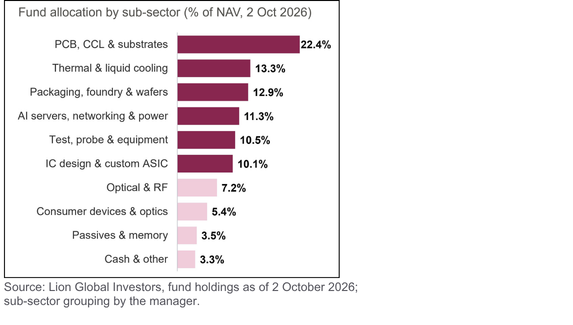
Our strategy: own the bottlenecks. When demand outruns supply, the companies that control scarce capacity gain pricing power and earnings upgrades. KGI forecasts 2026/2027 earnings growth of +394%/+80% for ABF substrates, +169%/+77% for CCL, +118%/+86% for test interface and +109%/+55% for thermal — far above the market.
RISKS
We are positive on the outlook, but we expect the path to include periods of volatility. These are the main risks and how we approach them.
| Risk | What could happen | How we manage it |
| US interest rates | The Fed raised rates to 3.75–4.00% on 16 September and the US 10-year yield is near 5.3%; Asian equities have historically struggled early in hiking cycles. |
Taiwan's earnings growth is far ahead of the region and positioning is light; we use rate-driven pullbacks to add2. |
| Oil and the Middle East | Brent has traded above US$100 per barrel. | Goldman Sachs estimates a ~4% earnings drag, but earnings have proved far more resilient; the fund has no direct energy exposure. |
| Valuation and short-term swings | The market trades at 18.6x forward earnings and corrected sharply in July before recovering. | We focus on companies with rising earnings forecasts, spread across 45 holdings. |
| AI investment timing | Power and permitting delays at US data centres could shift some server revenue between quarters. | We favour supply-constrained components and test over final assembly, where timing risk is highest. |
| Shortages and consumer demand | Memory, power-chip and glass-fabric shortages can delay shipments; high memory costs weigh on phone and personal computers (PC) volumes. | Consumer-device exposure is about 5% of the fund, and shortages also support our suppliers' pricing. |
| Concentration and TSMC | The fund is concentrated in technology and holds less TSMC than the index, so returns can differ meaningfully from the TAIEX. | This is deliberate: the fund is built to capture faster-growing suppliers and complements index holdings. |
| Geopolitics and currency | Cross-strait tensions or a weaker New Taiwan dollar could weigh on returns. | We monitor these closely; Goldman Sachs cross-strait risk index eased to 76 from 79 in September. |
1Source: KGI Securities, as of 30 September 2026.
2“Rate-driven pullbacks” refer to temporary market declines caused by changes in interest rate expectations.
Securities referenced are not intended as recommendations to buy or sell securities.
Past performance and the predictions, projections or forecasts on the economy, securities markets, bond markets or the economic trends of the markets are not necessarily indicative of the future or likely performance of the Fund/ portfolio.
All data are sourced from Lion Global Investors and Bloomberg as at 30 September 2026 unless otherwise stated.


