
Singapore offers investors a distinct combination of stability, income and long-term growth across both bond and equity markets. With a AAA sovereign credit rating, strong institutions, transparent regulations and stable rule of law, Singapore is widely regarded as one of the world’s safest and best-governed financial centres. This gives investors confidence in Singapore’s market structure, predictable policy framework and investment environment.
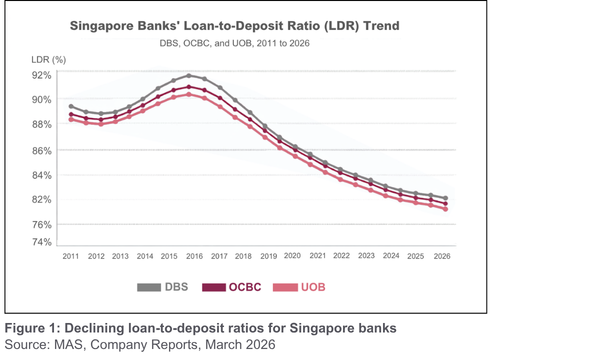
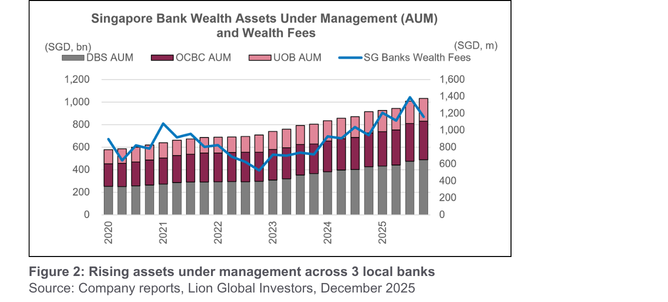
Amid geopolitical risk, inflation and uncertainty over major reserve currencies, Singapore offers both resilience and diversification. This safe-haven status is reflected in the increased liquidity in SGD in the form of lower loan-to-deposit Ratio (LDR) in Singapore’s three local banks (Figure 1) and steady rise of assets under management (AUM) across them, a sign of sustained capital inflows into the country (see Figure 2). If geopolitical tensions and global uncertainty persist, Singapore as a haven will continue to support both its bond and equity markets.
Singapore Bonds: Steady Income
Singapore’s bond market continues to offer attractive, dependable income today. With both cash rates and government yields low, Singapore dollar (SGD) corporate bonds stand out. A five-year investment grade SGD bond currently yields around 2.8-3.0% - a meaningful pickup over Singapore Government Securities, while still backed by high-quality issuers with strong balance sheets.
Looking closer at the investment proposition of Singapore bonds, three themes stand out.
1. The United States Fed Funds Rates vs Singapore Rates.
Currently, the bond market has largely priced in the risk of further Federal (Fed) rate hikes, reflecting concerns around previously elevated oil prices and their potential inflationary impact. With the expectations of an eventual cessation of the US–Iran conflict, inflation risks are expected to ease, reducing the urgency for additional monetary tightening. As a result, United States (US) interest rates are likely to remain near current levels, with the possibility of yields drifting lower as the risk of inflation recedes.
While Singapore rates track US Treasury yields due to global capital flows and financial market linkages, they are not solely dependent on the Fed. The Monetary Authority of Singapore (MAS) manages policy through the SGD Nominal Effective Exchange Rate (SGD NEER), using gradual currency appreciation to contain imported inflation. A stronger SGD, together with Singapore’s currency-based monetary policy give Singapore rates some differentiation from US interest rates, translating into lower yield volatility and more stable real returns for SGD-denominated bonds.
2. Defensive quality of Singapore bonds
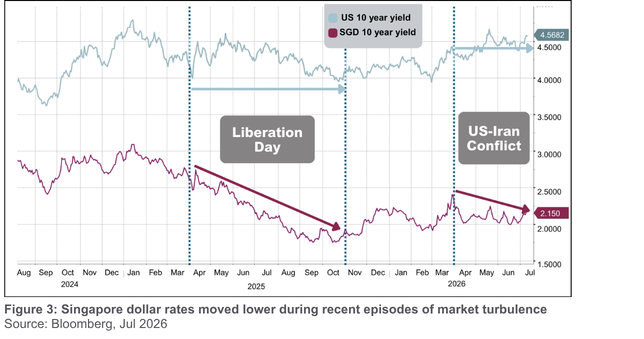
Recent market episodes have underscored the defensive characteristics of Singapore bonds. After the April 2025 “Liberation Day” tariff announcements, investors rotated away from USD exposure (de-dollarisation). SGD rates, which had broadly tracked USD rates during calmer periods, moved visibly lower during periods of market turbulence (see Figure 3), thereby outperforming US rates. A similar pattern emerged during the US-Iran conflict. These episodes demonstrated that Singapore bonds provide a safe haven for investors when confidence in US assets weaken.
3. Favourable demand-supply dynamics in Singapore corporate bonds
Supply of SGD corporate bonds remains limited each year, while a deep base of insurers, asset managers, private banks and institutions compete for it. This scarcity value keeps spreads from widening sharply even in volatile periods, supporting bond prices over time.
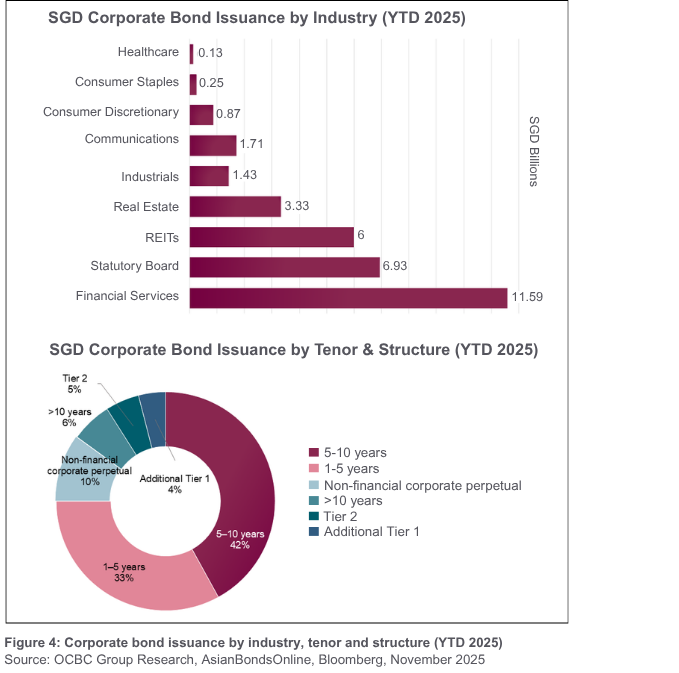
On the supply side, financial services led year-to-date (YTD) issuance at ~36%, with statutory boards and Real Estate Investment Trusts (REITs) making up much of the rest – sectors well-suited to insurers and institutions building SGD portfolios (see Figure 4). Issuance has also broadened into real estate, industrials, communications and debut Middle East-linked issuers. Green, social and sustainability-linked (GSS) bonds now account for ~25% of new issuances as well. The five to ten-year tenor dominates at 42%, matching where insurers and pension-linked investors want duration. Longer dated and subordinated issues remain a smaller slice, sustaining the market’s scarcity value.
Singapore Equities: From Steady Dividends to a Growing Opportunity
1. From stable to growing dividend market
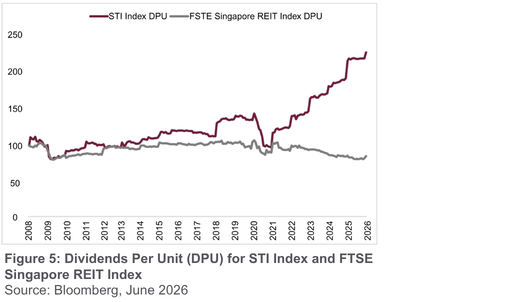
The Singapore equity market is well-established as a high dividend equity market. Dividends per share have been stable post-2008 Great Financial Crisis (GFC) but have notably increased in the period after 2020 COVID (see Figure 5). Importantly, while dividends offered by REITS remain stable, major sectors, including Financials, Industrials and Telecommunications,have seen increasing dividends. This is driven by the positive signalling effect from the Temasek Strategic Review of its portfolio investments to improve capital efficiency (2021) and improving earnings sustainability across these major sectors.
2. Sustainability of small- and mid-caps (SMIDs) Valuations
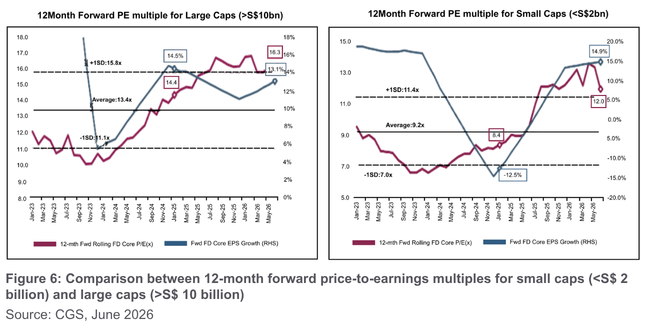
MAS’s Equity Market Development Programme (EQDP) – S$6.5 billion committed and S$3.95 billion announced as of 19 November 2025 – has boosted activity in local equities. Small-caps have performed well since 2025, re-rating from below 10x to around12x price-to-earnings (PE), still attractive against approximately 15% growth expectations, versus large caps at approximately 16x PE with around13% growth (see Figure 6).
3. Structural tailwinds for SMIDs
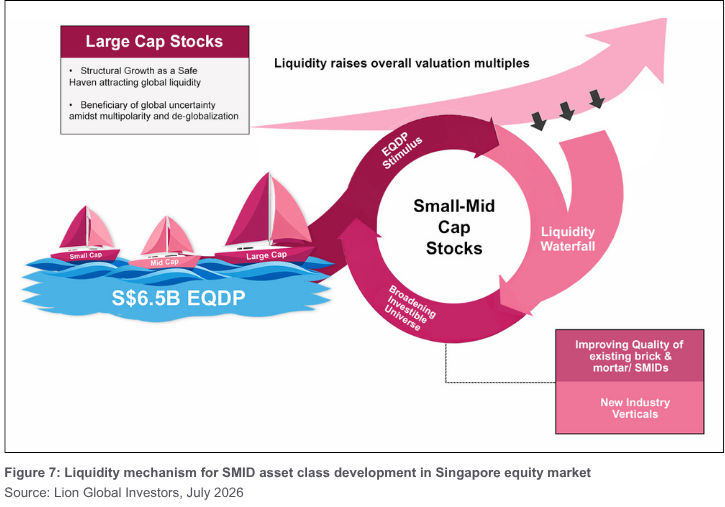
Potential Central Provident Fund (CPF) revisions in 2028 would allow greater equity allocation, extending liquidity support for SMIDs beyond EQDP’s 2027 runway. The STI is also benefitting from Singapore’s growing safe-haven status amid prolonged geopolitical uncertainty, a trend likely to persist beyond 2026. Rising global capital seeking stability may keep re-rating Singapore equities, while more growth-oriented SMIDs may list on the Singapore Exchange, expanding the investible universe and creating a virtuous cycle of market development (see Figure 7).
Singapore bonds and equities serve different but complementary roles. Bonds provide stability, risk-adjusted income and downside resilience, especially valuable during market turbulent periods. Equities offer sustainable dividends and long-term growth from companies in one of Asia’s most well-governed markets. Together, they give investors exposure to the Singapore market’s strengths: sound governance, currency strength, institutional depth and income-oriented investment strategies.
Amid global uncertainty and concerns over US asset exposure, Singapore offers a credible alternative for investors seeking high-quality Asian exposure and diversification.
All data are sourced from Lion Global Investors and Bloomberg as at 16 July 2026 unless otherwise stated.


