
2026 Sustainability Article

23 Apr 2026
Chan Wen Jie - Head, ESG

WE’VE BEEN THINKING ABOUT DECARBONISATION ALL WRONG

For too long, the conversation around sustainability has been framed as a zero-sum game. We are often told that to "save the planet," we must make trade-offs that might stifle economic growth, accept higher costs and make sacrifices. This narrative is not only demoralising, but also fundamentally incorrect.

Decarbonisation does not have to be a bitter pill we must swallow to offset the "sins" of progress. Instead, a low-carbon reality is the natural outcome of doing things better.

CARBON REDUCTION AS A MULTI-BENEFIT OUTCOME

If we stop chasing "carbon" as an isolated metric and instead focus on "good things," we find that decarbonisation can happen by default. Consider the following:

1.Energy security

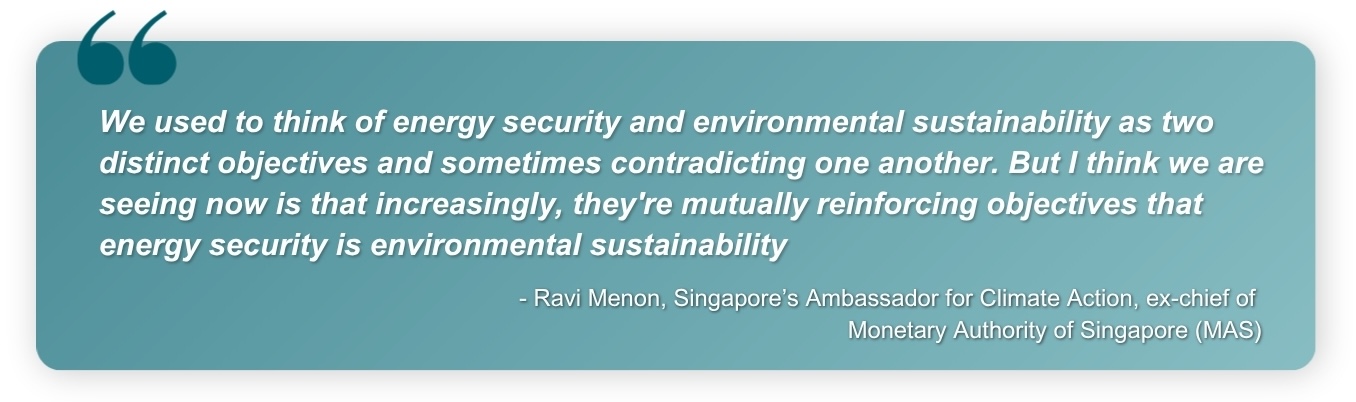
Relying on volatile global fossil fuel markets is a strategic risk. The current Middle East conflict has clearly shown us why. When a nation invests in localised renewable grids such as wind, solar, and maybe even nuclear, it isn't just "going green.", it is securing its independence. A secure energy grid is inherently a lower-carbon grid.
2. Technological innovation

Yes, renewable energies bring with it its own set of issues such as intermittency that pressure the grid. But the solution to that is simple: batteries. Batteries help convert variable renewable energies into a fixed stable energy source. Quite importantly, batteries represent a set of foundational technologies that enable further technological advancement. Can you imagine your humanoid robots being corded or powered by fuel? This is an example of how a low carbon future is synonymous with growth and innovation. It is not a "cost". It’s a multi-trillion-dollar market opportunity.

3. Energy Efficiency: Doing More with Less

Decarbonisation is often just another word for resource efficiency. Every kilogram of carbon not emitted usually represents a kilowatt-hour of energy saved or raw materials used more effectively. A factory that optimises its heat recovery systems is not just meeting a sustainability goal; it’s lowering its cost structure and being more competitive. Low carbon can be synonymous and compatible with lower cost and higher profitability. 

4. Heritage Conservation and Circularity

The greenest building may be the one that already exists. Heritage conservation is often viewed as a niche aesthetic preference, but it is actually a masterclass in sustainability. By retrofitting historic structures, we avoid the massive "embodied carbon" costs of new concrete and steel. We preserve the soul of our cities while naturally lowering their carbon footprint.

THE NEW FRAMEWORK: ABUNDANCE, NOT AUSTERITY

To reach a sustainable future, we must shift our language from "minimisation" to "optimisation." We are not looking for a world with less. We are looking for a world with better.

We should not be trading growth for sustainability. Rather, sustainable growth is the only kind of growth that is economically and socially durable. 

Decarbonisation is an emergent property of well-functioning systems.

When countries strengthen energy security, emissions fall.
When technological innovation happens, emissions fall.
When companies improve efficiency, emissions fall.
When societies conserve valuable assets, emissions fall.
These are not sacrifices. They are improvements.

The path to a lower-carbon world is therefore not defined primarily by what we must give up, but by what we can build: more resilient energy systems, more technological innovation, more efficient industries, and more thoughtful stewardship of the resources we already have.

Decarbonisation, in this sense, is not the destination. It is the footprint left behind when progress moves in the right direction.

CONNECTING THE DOTS IS REWARDING

The connection between a low carbon outcome and all that we mentioned is not always immediately obvious. But if one is able to connect the dots as we did, it can reveal interesting investment opportunities that could be financially rewarding for a stock-picker.

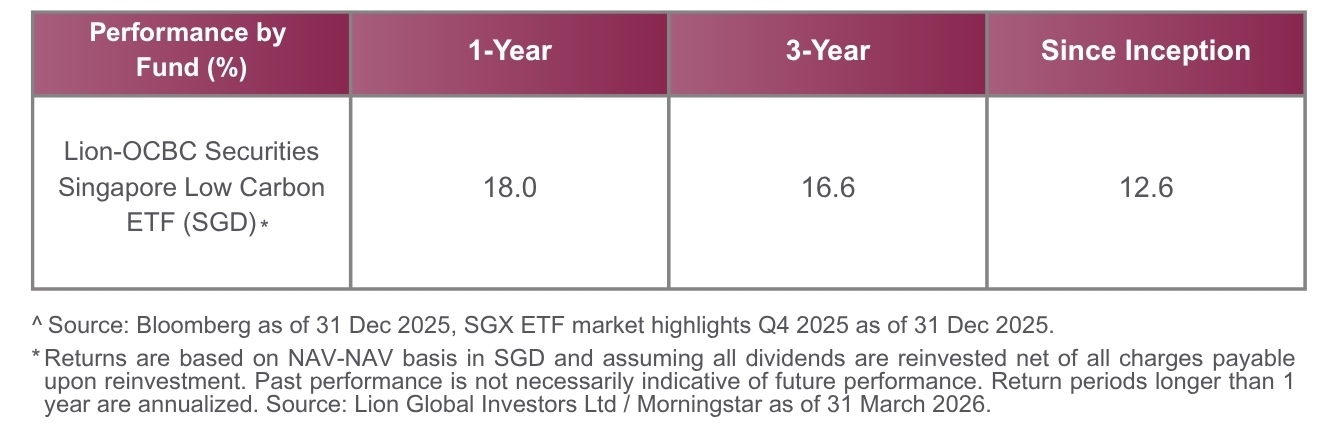
For those that are too busy to pick stocks, the alternative option could be to participate via a diversified basket of stocks or ETFs. Take for instance, the Lion-OCBC Securities Singapore Low Carbon ETF, which provides diversified exposure to Singapore corporates with a lower carbon footprint. In 2025, this ETF was the top-dividend paying Singapore equities ETF listed on SGX and cumulatively outperformed other Singapore-focused ETFs  since its listing, demonstrating that sustainability considerations can be integrated with financial performance. 

Invest in the Lion-OCBC Securities Singapore Low Carbon ETF – Singapore’s Top Green Leaders. All in One ETF.
Download Report

Share this article

Latest Insights

Disclaimer

DISCLAIMER - LION GLOBAL INVESTORS LIMITED

This advertisement or publication has not been reviewed by the Monetary Authority of Singapore. It is for information only, and is not a recommendation, offer or solicitation for the purchase or sale of any capital markets products or investments and does not have regard to your specific investment objectives, financial situation, tax position or needs. 
You should read the prospectus and Product Highlights Sheet of the Lion-OCBC Securities Singapore Low Carbon ETF (“ETF”), which is available and may be obtained from Lion Global Investors Limited (“LGI”) or any of the its distributors and appointed Participating Dealers (“PDs”), for further details including the risk factors and consider if the ETF is suitable for you and seek such advice from a financial adviser if necessary, before deciding whether to purchase units in the ETF. 
Investments in the ETF are not obligations of, deposits in, guaranteed or insured by LGI or any of its affiliates and are subject to investment risks including the possible loss of the principal amount invested. The performance of the ETF is not guaranteed and, the value of its units and the income accruing to the units, if any, may rise or fall. Past performance, payout yields and payments, as well as, any prediction, projection, or forecast are not necessarily indicative of the future or likely performance, payout yields and payments of the ETF. Any extraordinary performance may be due to exceptional circumstances which may not be sustainable. Dividend distributions, which may be either out of income and/or capital, are not guaranteed and subject to LGI’s discretion. Any such dividend distributions will reduce the available capital for reinvestment and may result in an immediate decrease in the net asset value of the ETF. Any references to specific securities are for illustration purposes and are not to be considered as recommendations to buy or sell the securities. It should not be assumed that investment in such specific securities will be profitable. There can be no assurance that any of the allocations or holdings presented will remain in the ETF at the time this information is presented. Any information (which includes opinions, estimates, graphs, charts, formulae or devices) is subject to change or correction at any time without notice and is not to be relied on as advice. You are advised to conduct your own independent assessment and investigation of the relevance, accuracy, adequacy and reliability of any information or contained herein and seek professional advice on them. No warranty is given and no liability is accepted for any loss arising directly or indirectly as a result of you acting on such information. The ETF may, where permitted by the prospectus, invest in financial derivative instruments for hedging purposes or for efficient portfolio management. The ETF’s net asset value may have higher volatility as a result of its narrower investment focus on a limited geographical market, when compared to funds investing in global or wider regional markets. LGI, its related companies, their directors and/or employees may hold units of the ETF and be engaged in purchasing or selling units of the ETF for themselves or their clients.
The units of the ETF are listed and traded on the Singapore Exchange Securities Trading Limited (“SGX-ST”), and may be traded at prices different from its net asset value, suspended from trading, or delisted. Such listing does not guarantee a liquid market for the units. You cannot purchase or redeem units in the ETF directly with the manager of the ETF, but you may, subject to specific conditions, do so on the SGX-ST or through the PDs. 
© Lion Global Investors Limited (UEN/ Registration No. 198601745D). All rights reserved. LGI is a Singapore incorporated company and is not related to any corporation or trading entity that is domiciled in Europe or the United States (other than entities owned by its holding companies).

DISCLAIMER - SINGAPORE EXCHANGE LIMITED

The units in the Lion-OCBC Securities Singapore Low Carbon ETF are not in any way sponsored, endorsed, sold or promoted by the Singapore Exchange Limited (“SGX”) and/or its affiliates and SGX and its affiliates make no warranty or representation whatsoever, expressly or impliedly, either as to the results to be obtained from the use of the iEdge-OCBC Singapore Low Carbon Select 40 Capped Index and/or the figure at which the iEdge-OCBC Singapore Low Carbon Select 40 Capped Index stands at any particular time on any particular day or otherwise. The iEdge-OCBC Singapore Low Carbon Select 40 Capped Index is administrated, calculated and published by SGX. SGX shall not be liable (whether in negligence or otherwise) to any person for any error in the Lion-OCBC Securities Singapore Low Carbon ETF and the iEdge-OCBC Singapore Low Carbon Select 40 Capped Index and shall not be under any obligation to advise any person of any error therein.
OCBC is a registered trade mark of Oversea-Chinese Banking Corporation Limited and is used under licence. Save for the foregoing, all intellectual property rights in the iEdge-OCBC Singapore Low Carbon Select 40 Capped Index vest in SGX. The iEdge-OCBC Singapore Low Carbon Select 40 Capped Index is used by Lion Global Investors Limited under licence

]